
Monday, February 28, 2011
Second Life Performance Idea
I think it would be cool and interesting to have the whole class give their avatars zombie skin and have us walk around Second Life as a group. From what I have seen in Second Life, everyone dresses their avatars up to match their fantasies, be it furries, princesses, tall masculine men or other things along those lines. No one that I have seen has a scary avatar and they do not crowd around in a pack or like bodied scary avatars. I think it would cause a cool reaction within Second Life and it would be very interesting to hear what people would say when a horde of zombies invades their club or area.


Tuesday, February 15, 2011
Create an Object in Second Life

This is the coffee table I made in Second Life. I had never worked with any type of 3D modeling and though I don't think I used it to it's full potential, I had a good time playing around with the tools and orienting myself with the controls. I decided to paint the table with a southwest pattern to spice it up a little bit and complete my first object build in Second Life.
Second Life self-portraiture


Here are a couple pictures of my avatar in Second Life as well as a picture of me taken tonight. I've grown a little bit of facial hair since I took the picture for my Second Life skin, but otherwise I think it's pretty spot on. I spent a lot of time in photoshop trying to get my skin to line up with the avatar and I think it turned out good. I want to work on the skin tone and some other small things when I get time and have my avatar perfect.
Tuesday, February 1, 2011
Reading Questions February 2nd 2011
Questions based on the reading of http://blog.art21.org/2010/04/21/art-the-avatar-ambiguity-of-identity-in-virtual-3d-worlds/
1. Where are the highest concentrations of Second Life users in the world and what is the most common sex and race of these users?
2. Is Second Life a world of fantasy for most residents or merely an extension of their real lives?
1. Where are the highest concentrations of Second Life users in the world and what is the most common sex and race of these users?
2. Is Second Life a world of fantasy for most residents or merely an extension of their real lives?
Tuesday, January 25, 2011
PROJECT 1 - HUD

For my HUD I decided to center the display around a picture I took while riding my motorcycle. I thought it worked perfectly and looked exactly like a HUD from a driving game. Surrounding the frame are icons for what I normally do in a day. Up top are a snowboard and skateboard representing my normal exercise activities given the time of year. Below that is a cell phone because none of us can live without them anymore. On the top right is a slice of pizza representing the food I need to eat. Below the pizza are a stack of books representing schoolwork and finally there is a bed for sleep, something i don't seem to get enough of!
Thursday, December 9, 2010
Individual Paper
Coming into this class I had a very small idea of what Digital Art really encompassed. I was under the impression that it was mostly limited to graphic design and video projects like 3D animation. During the span of the course my eyes were opened to the nearly limitless possibilities of Digital Art and the many ways people are using it currently. One thing that I took from all this that stood out above the rest it the interactivity that is allowed through the many digital mediums. I really like the idea of being able to interact with a piece without actually changing it for the next person. With a group painting, for example, many people are able to add their own nuances to a piece, but ultimately their work will be painted over at least partially and when the paint dries, there is no more interactivity available. With the digital medium, users can change something or add to it, but without altering the piece beyond its original intention. Gregory Shakar and Don Ritter are both artist that use Digital Art as their mediums and the both specialize in projects that require interaction from the audience to complete the piece. The audience can alter the work as the feel fit, but ultimately their art is still relatively unchanged in the long run, allowing for unlimited use.
Don Ritter is a Canadian artist and writer living and working in Berlin. He aims to create social portraits through the audiences participation of his interactive art installations. The content of his work is conveyed to audiences experientially, through the physical actions they perform within the installations. Ritter's subject matter includes hegemony, servility, commodification of tragedy, and mechanisms of authority. Between 1988 and 1993, he focused his work on performances of interactive video controlled by live, improvised music. Since 1986, Ritter’s installations and performances have been exhibited at festivals and museums throughout Europe, North America and Asia. Intersection, his most widely exhibited work, is an interactive sound installation that requires visitors to walk through the sounds of car traffic in a large dark room. Since it opened in 1993, over 600,000 people have experienced Intersection. Don Ritter is also educated in many areas of Art as well as psychology and has earned degrees in Fine Arts and Psychology from the University of Waterloo, Electronics Engineering Technology from the Northern Alberta Institute of Technology, a Masters in Visual Studies from Massachusetts Institute of Technology, and he has also studied cinema at Harvard University.

The piece that really stood out to me above Ritter’s other work was Skies. The interactive video and sound installation, first shown in 1998, involves two projectors, one aimed at the floor and the other on an adjacent wall. Both projectors display 16 meter by 16 meter video of night sky in the dark room when no one is interacting with the piece. When visitors walk onto the projection, black paths appear under their feet at specific locations. They then follow the paths until new paths are discovered through walking around. With one user, only one path is available at a time. When they get to the intersection of two paths, the old one disappears and a new one is show. As the five hidden paths are discovered the imagery and sound transform according to the specific paths discovered.

The more users that interact with Skies, the more paths become available at a time. Depending on which paths are found and being, the environment projected will be a night sky, day sky, water, land, or a sunny sky. If their are two users interacting with the piece, two paths are displayed at once. When a third user enters Skies, a third path is presented and so on until all 5 paths are in use. Once a user steps off the path and loses his place, the path disappears as fast as it appeared and the user must wader the piece until another path is presented. The installation uses a collaborative interface of motion sensors which form a hierarchy of imagery and sound based on the cooperation of the visitors. Skies requires that people cooperate with each other in order to experience the work completely. The installation can accommodate an unlimited number of viewers, but only 5 users can interact with it at a time.
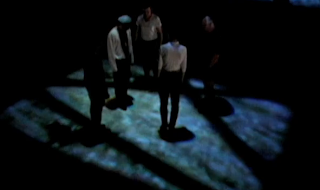
According to Ritter, "the interactive component of this installation was designed to be meaningful, because the viewers--possibly strangers to each other-- have to cooperate with each other in order to experience the entire work. When this work has been exhibited, viewers began speaking to each other as they attempted to discover all the levels and sequences of imagery. Their cooperation with the nature imagery--as detected by the interactive system--is the content of the work."
http://vimeo.com/17189602
I really like the interactivity involved with Skies. Its one of the first pieces that I have seen that doesn't even work without interaction. I can imagine Skies in a gallery space and the first people walking in not even knowing the possibilities of it. They might walk over it and then become startled as it changes below their feet, forcing them to work with it to enact more change. Its really interesting how the piece changes with interaction from the users, but also dictates actions for the users. Even though it is a video piece from a viewers perspective, the motion sensors that pick up the movement of the people allow it to be much more than just video. The required cooperation of participants also forces people to interact with one another while interacting with the piece. In a world of stale art galleries where people wander around whispering and staring at paintings, Skies changes the stereotype and requires strangers to interact with each other just to experience the piece as a whole.
Gregory Shakar, a life-long resident of New York City, is an artist and musician that seeks to reveal the emotive implications of electronic media and physical devices through his work. Early in his career he composed electronic music, played guitar, bass and other instruments, and also did production and audio engineering for noise bands. Shakar’s current interests lie in the intersection of sculpture, installation art, product design, performance and computational media. He has employed over-sized undulating pixels, melodic electrical arcs and towering sonorous metronomes as parts of his interactive installations. Shakar's solo work and collaborative performances have been presented worldwide, including venues in New York, London, Tokyo, Berlin, Rome, Barcelona, Geneva, Montreal, Turin, Bergen and Kyoto. He has been an Artist in Residence at the Ars Electronica Center in Linz, Austria and served as both a Fellow and a Resident Researcher at New York University's Interactive Telecommunications Program. Shakar , as educated as he in accomplished, holds a both a Bachelors Masters Degree from NYU's Gallatin School of Individualized Study, where he is currently an Adjunct Professor.

Shakar’s installation entitled Analog Color Field Computer caught my eye because of the initial simplicity, but held my attention because of the varying degrees of interaction that are allowed by the piece. The Analog Color Field Computer is an interactive video and sound installation that makes use of altered computer monitors changed to display only one color. Exhibitions of the piece include a number of monitors with custom electronics drives corresponding loudspeakers. Instead of presenting complex images that have become commonplace n computer screens today, the Analog Color Field Computers display a solid field of color at any one time. Likewise with sound, instead of producing complex music or other audio, the speakers on each unit only emit one pure tone that that can be altered by volume and pitch.
http://www.moodvector.com/acfc/acfcvideoVoiceover.htm
The monitor’s colors and tones surge in steady pulses, conveying sonic textures and luminescent patterns into the sparsely lit exhibition space. When the screen is turned to its brightest level, the tone is increased to its loudest and when the screen fades to black, the tone diminishes to silence. Users are able to control the output via knobs on the bottoms of the monitors. On each unit are knobs for adjusting red, green and blue colors as well as the tone and pitch of the sound and one for the speed of the throb and pulsation of the screens. The combinations of red, green and blue allow for the creation of any color. In the dimly lit room, the blinking and flashing screens flash color across the faces of the users and onto the surrounding walls.

According to Vague Terrain “the fundamental aesthetic inspiration for the piece is the ghostly illumination that can be witnessed as emanations from lonely urban windows in the dead of night. This is the signature flickering glow of video screens in unlit rooms. The installation seeks to capture and optimize this lovely and spooky vision. It serves to elicit the churning moods and sentiments that emerge from simple, solitary moments of wonderment in our modern lives.” In this light, the Analog Color Field Computer becomes a nod to past technology and a window into its role in our current lives and the implications of technology in our future.
These two pieces, though very different, both require interaction from the users to bring out the full potential. With Skies, users must walk around and while doing so, they change the landscape and sound of the installation both on the ground and on the wall. With Analog Color Field Computer, users spin knobs to create changes both on the screen and out of the speakers. They differ in the fact that Skies, while being changed by the users, also forces them to interact with each other and dictates where they should walk. It is an inverse relationship that I believe is very unique, especially for something controlled not by man, but by a computer program.
This semester really opened up my eyes the possibilities of Digital Art and these two installations are just a small representation of that. The interactive nature of these pieces really makes them stand out above the rest. Even though they are both quite simple by today’s technological standards, the message they send and the way they communicate with the users allows them to be timeless.
Sources:
http://www.moodvector.com/acfc/
http://www.hz-journal.org/n11/shakar.html
http://we-make-money-not-art.com/archives/2007/01/the-analog-colo.php
http://colinhuff.wordpress.com/2008/02/19/artist-presentation-don-ritter/
http://aesthetic-machinery.com/articles-myfinger.html
http://aesthetic-machinery.com/skies
Don Ritter is a Canadian artist and writer living and working in Berlin. He aims to create social portraits through the audiences participation of his interactive art installations. The content of his work is conveyed to audiences experientially, through the physical actions they perform within the installations. Ritter's subject matter includes hegemony, servility, commodification of tragedy, and mechanisms of authority. Between 1988 and 1993, he focused his work on performances of interactive video controlled by live, improvised music. Since 1986, Ritter’s installations and performances have been exhibited at festivals and museums throughout Europe, North America and Asia. Intersection, his most widely exhibited work, is an interactive sound installation that requires visitors to walk through the sounds of car traffic in a large dark room. Since it opened in 1993, over 600,000 people have experienced Intersection. Don Ritter is also educated in many areas of Art as well as psychology and has earned degrees in Fine Arts and Psychology from the University of Waterloo, Electronics Engineering Technology from the Northern Alberta Institute of Technology, a Masters in Visual Studies from Massachusetts Institute of Technology, and he has also studied cinema at Harvard University.

The piece that really stood out to me above Ritter’s other work was Skies. The interactive video and sound installation, first shown in 1998, involves two projectors, one aimed at the floor and the other on an adjacent wall. Both projectors display 16 meter by 16 meter video of night sky in the dark room when no one is interacting with the piece. When visitors walk onto the projection, black paths appear under their feet at specific locations. They then follow the paths until new paths are discovered through walking around. With one user, only one path is available at a time. When they get to the intersection of two paths, the old one disappears and a new one is show. As the five hidden paths are discovered the imagery and sound transform according to the specific paths discovered.

The more users that interact with Skies, the more paths become available at a time. Depending on which paths are found and being, the environment projected will be a night sky, day sky, water, land, or a sunny sky. If their are two users interacting with the piece, two paths are displayed at once. When a third user enters Skies, a third path is presented and so on until all 5 paths are in use. Once a user steps off the path and loses his place, the path disappears as fast as it appeared and the user must wader the piece until another path is presented. The installation uses a collaborative interface of motion sensors which form a hierarchy of imagery and sound based on the cooperation of the visitors. Skies requires that people cooperate with each other in order to experience the work completely. The installation can accommodate an unlimited number of viewers, but only 5 users can interact with it at a time.

According to Ritter, "the interactive component of this installation was designed to be meaningful, because the viewers--possibly strangers to each other-- have to cooperate with each other in order to experience the entire work. When this work has been exhibited, viewers began speaking to each other as they attempted to discover all the levels and sequences of imagery. Their cooperation with the nature imagery--as detected by the interactive system--is the content of the work."
http://vimeo.com/17189602
I really like the interactivity involved with Skies. Its one of the first pieces that I have seen that doesn't even work without interaction. I can imagine Skies in a gallery space and the first people walking in not even knowing the possibilities of it. They might walk over it and then become startled as it changes below their feet, forcing them to work with it to enact more change. Its really interesting how the piece changes with interaction from the users, but also dictates actions for the users. Even though it is a video piece from a viewers perspective, the motion sensors that pick up the movement of the people allow it to be much more than just video. The required cooperation of participants also forces people to interact with one another while interacting with the piece. In a world of stale art galleries where people wander around whispering and staring at paintings, Skies changes the stereotype and requires strangers to interact with each other just to experience the piece as a whole.
Gregory Shakar, a life-long resident of New York City, is an artist and musician that seeks to reveal the emotive implications of electronic media and physical devices through his work. Early in his career he composed electronic music, played guitar, bass and other instruments, and also did production and audio engineering for noise bands. Shakar’s current interests lie in the intersection of sculpture, installation art, product design, performance and computational media. He has employed over-sized undulating pixels, melodic electrical arcs and towering sonorous metronomes as parts of his interactive installations. Shakar's solo work and collaborative performances have been presented worldwide, including venues in New York, London, Tokyo, Berlin, Rome, Barcelona, Geneva, Montreal, Turin, Bergen and Kyoto. He has been an Artist in Residence at the Ars Electronica Center in Linz, Austria and served as both a Fellow and a Resident Researcher at New York University's Interactive Telecommunications Program. Shakar , as educated as he in accomplished, holds a both a Bachelors Masters Degree from NYU's Gallatin School of Individualized Study, where he is currently an Adjunct Professor.
Shakar’s installation entitled Analog Color Field Computer caught my eye because of the initial simplicity, but held my attention because of the varying degrees of interaction that are allowed by the piece. The Analog Color Field Computer is an interactive video and sound installation that makes use of altered computer monitors changed to display only one color. Exhibitions of the piece include a number of monitors with custom electronics drives corresponding loudspeakers. Instead of presenting complex images that have become commonplace n computer screens today, the Analog Color Field Computers display a solid field of color at any one time. Likewise with sound, instead of producing complex music or other audio, the speakers on each unit only emit one pure tone that that can be altered by volume and pitch.
http://www.moodvector.com/acfc/acfcvideoVoiceover.htm
The monitor’s colors and tones surge in steady pulses, conveying sonic textures and luminescent patterns into the sparsely lit exhibition space. When the screen is turned to its brightest level, the tone is increased to its loudest and when the screen fades to black, the tone diminishes to silence. Users are able to control the output via knobs on the bottoms of the monitors. On each unit are knobs for adjusting red, green and blue colors as well as the tone and pitch of the sound and one for the speed of the throb and pulsation of the screens. The combinations of red, green and blue allow for the creation of any color. In the dimly lit room, the blinking and flashing screens flash color across the faces of the users and onto the surrounding walls.
According to Vague Terrain “the fundamental aesthetic inspiration for the piece is the ghostly illumination that can be witnessed as emanations from lonely urban windows in the dead of night. This is the signature flickering glow of video screens in unlit rooms. The installation seeks to capture and optimize this lovely and spooky vision. It serves to elicit the churning moods and sentiments that emerge from simple, solitary moments of wonderment in our modern lives.” In this light, the Analog Color Field Computer becomes a nod to past technology and a window into its role in our current lives and the implications of technology in our future.
These two pieces, though very different, both require interaction from the users to bring out the full potential. With Skies, users must walk around and while doing so, they change the landscape and sound of the installation both on the ground and on the wall. With Analog Color Field Computer, users spin knobs to create changes both on the screen and out of the speakers. They differ in the fact that Skies, while being changed by the users, also forces them to interact with each other and dictates where they should walk. It is an inverse relationship that I believe is very unique, especially for something controlled not by man, but by a computer program.
This semester really opened up my eyes the possibilities of Digital Art and these two installations are just a small representation of that. The interactive nature of these pieces really makes them stand out above the rest. Even though they are both quite simple by today’s technological standards, the message they send and the way they communicate with the users allows them to be timeless.
Sources:
http://www.moodvector.com/acfc/
http://www.hz-journal.org/n11/shakar.html
http://we-make-money-not-art.com/archives/2007/01/the-analog-colo.php
http://colinhuff.wordpress.com/2008/02/19/artist-presentation-don-ritter/
http://aesthetic-machinery.com/articles-myfinger.html
http://aesthetic-machinery.com/skies
Wednesday, December 8, 2010
Lecture Review: Cory Arcangel
Cory Arcangel is a computer artist who lives and works in Brooklyn. While studying music in school, he realized that making money as a musician would be hard and instead changed his focus to computer programming. In his free time he began to hack into other peoples programs to mess with them. He describes on such program that he altered to shut down peoples computers and simultaneously open their CD drive when they opened an email. What began as fun and games for Arcangel turned into his career.
Most of his current projects are now based around hacking program codes to make art out of the altered result. In his “Data Diaries” piece, he saved pieces of the memory on his computer every day for a month. He then converted these bits of code into colors created a movie of the 16bit color scheme that randomly displayed oscillating shapes of brightly colored pixels.
Arcangels “Beach Boys/Geto Boys” piece caught my eye because of its similarity with the YouTube remix project that we did in class. I really liked this piece because it was so simple to create, yet the creative vision that went into was anything but simple. With so many popular mix CD’s of artist mashups, this was the first I’ve seen on video and with more implication than just sounding cool. I think he really has a deeper meaning on the direction of American pop culture and its change over time with his piece as well. After all, he did say that "Nothing in my mind has any significance unless it is attached to some kind of culture."
If I was present at the lecture I would have liked to ask Arcangel if he has ever gotten into any trouble as a result of his hacking. I would also like to know where's he stands on the concept of intellectual property since he mentions that his work basically "steals" aesthetics and similar concepts from other people.
Subscribe to:
Posts (Atom)